- Autobiographical Order
- Posts
- Stone Roses and that one great album
Stone Roses and that one great album
Plus: Oneida, My Brightest Diamond, Eli Winter and For Against

Jeffrey Terich
November 30, 2025
Programming note: If you’ve been keeping up with this new and improved version of Autobiographical Order in the past year, you’ll notice that things are a little different today. The idea was to move the list along faster if I’m doing 7 at a time, but what I didn’t consider was that this theory falls apart if I’m publishing less often because I have to do more records per post. Seven was an arbitrary number—I used to do three records per post on Wordpress and that didn’t seem like enough, but obviously 7 was too cocky on my part. So we’re going with 5 and see where that gets us. Hopefully at least one post per week. Fingers crossed.

No. 1386: The Stone Roses - s/t
Last week, legendary bassist for The Stone Roses, Gary “Mani” Mounfield, died at the age of 61. Which makes my timing on this post either awful or perfect, but it still gives this post an unfortunate elegiac feeling when it should have been, instead, simply a celebration of a great band’s one great album. Yes, technically, they had two, but few people ride that hard for Second Coming, and the band had broken up by the time it was released. So one album it is!
The influence of The Stone Roses is immeasurable, from the influence they had on Britpop to electronic dance music and even contemporary punk bands like High Vis and Militarie Gun. (I don’t know if Militarie Gun is specifically influenced by Stone Roses, but you can hear Madchester in songs like “Very High,” for sure.)
I’ll be the first to admit I didn’t quite get it the first time I heard it; not that the songs weren’t good, but it sounded to me like a lot of other bands. What I didn’t appreciate at the time was how much earlier they did it, and how much better they did it. “I Am the Resurrection” is better than literally any Oasis song, and I like Oasis, and I’m pretty sure Oasis wouldn’t disagree with me. This isn’t meant as an insult against Oasis, but rather a rock-solid fact about The Stone Roses. Pun not intended, or maybe it was. (My colleague Laura, I should note, listened to this record for the first time in the past week and is 100 percent agreement with me based on our conversation after the fact.)
And somehow, in a 10 out of 10 record, where every song is a 10, including the one that plays backwards, “I Wanna Be Adored,” the leadoff track, is still somehow the best. (I don’t love it when albums peak on the first song but if it’s an 11/10 followed by nothing but 10/10 songs, then that’s not a problem.) And the thing driving it is Mani’s bassline, just a legendary and massive piece of Manchester music history that has lost none of its power in 36 years. Rating: 10.0
Listen: “I Wanna Be Adored”

No. 1387: Oneida - Success
You can typically tell what bands I’m obsessing over at any given time by seeing how often they show up in quick succession in this series. Just a few entries ago, I offered the introduction of one of them I had in 2022: Oneida. To reiterate, they weren’t a new discovery to me at the time. I’d first heard them in the mid-’00s, and while in hindsight I think The Wedding was actually the first of their albums I’d heard, Happy New Year was the one that really drew me in in a big way.
Fast forward to 2022, and I’m newly mesmerized by their sound due to their then-new album Success. It’s a surprisingly straightforward record, with jangly, ragged rock ‘n’ roll guitar at the center of these songs. It’s not that their previous records didn’t have guitar, but most of them are more defined by noisy keyboards, or various other sounds, like the music-box gamelan kosmische of “History’s Great Navigators.” But this is a guitar rock record, and a damn good one, and part of why it succeeds as well as it does is due to the fact that they generally don’t make this sort of record that often. It’s summery, fun, just a rock ‘n’ roll good time.
It still sounds like Oneida, in large part due to longer mind-melters like “Paralyzed” and “Low Tide.” But the meat and potatoes of this record are two- and three-chord rockers like “Beat Me to the Punch” and “Rotten,” and the punk rock ripper “Opportunities,” which never overstay their welcome. But they could easily go for a few minutes longer and I’d be perfectly happy with that.
This isn’t the last of Oneida you’ll see in Autobiographical Order, and the next one is much deeper on their psych freakout scale. Rating: 8.9
Listen: “Opportunities”

No. 1388: My Brightest Diamond - Bring Me the Workhorse
For a few years back in the mid- to late-’00s, it seemed possible that a string of new indie stars would be propelled to the limelight thanks to their time spent playing in Sufjan Stevens’ band. It happened at least twice. The second and more famous of the two solo artists to have emerged from Stevens’ band was St. Vincent, who also was part of the Polyphonic Spree’s touring band briefly. The other, who’s had modest success but not quite on the level of Annie Clark, is My Brightest Diamond. They released their debut albums within a year of each other, and they shared some similarities, but one leaned more Kate Bush (St. Vincent, at least at the time) and the other more PJ Harvey.
Bring Me the Workhorse is a dark album, gorgeous and intoxicating but eerie and haunting nonetheless. At times she evokes the nocturnal trip-hop of Portishead on a song like “Disappear” or the uneasy and skeletal “We Were Sparkling,” while the massive opener “Something of An End” is a bit like a less menacing “Rid of Me.” She’s a stellar songwriter, capable of evoking darkness and emotional depth in equal measure, and after nearly two decades, this still stands as one of the best albums of 2006 in my mind, and though it was acclaimed at the time, it seems to have faded from memory. That happens. The way of the world.
I’ve in recent years been playing a kind of long-game of snatching up records that resonated with me anywhere from 20-30 years ago (millennial nostalgia? Maybe, but don’t mistake this for some embarrassing “Emo Nite” nonsense), many of which haven’t been reissued in any form. Which is a shame. This one certainly merits it, and wasn’t easy to find, though I was able to track down an inexpensive copy. Digital crate digging isn’t always as fun, but it can end up being just as satisfying when you arrive upon that long-awaited find. Rating: 9.2
Listen: “Something of an End”

No. 1389: Eli Winter - s/t
Eli Winter has grown from an artist I enjoy and respect to one who has delivered some truly spectacular music in only a few years’ time. His self-titled record introduces itself as a modern permutation on American primitivist folk music, full of gorgeously performed guitar work and some full-band arrangements reminiscent of the post-rock of a group like Gastr del Sol (whose Jim O’Rourke has released some American primitivist music of his own). It’s the pastoral old-new weird Americana with the sound of the Chicago school, a blend that just plain works.
The deeper you get into this album, though, the more Winter’s sound begins to drift from where it began, particularly on a standout like “Dayenu,” which features flugelhorn from the late jaimie branch. It’s not quite jazz, but it’s not not jazz, and on his next album—one of my favorites this year that I hope I don’t end up waiting five years to write about in this series—he essentially makes the leap from not jazz to definitely jazz. It’s glorious.
This self-titled album is nonetheless a beautiful record full of compositions that reveal themselves in time, beautiful, gentle and full of surprises. Rating: 8.9
Listen: “Dayenu”
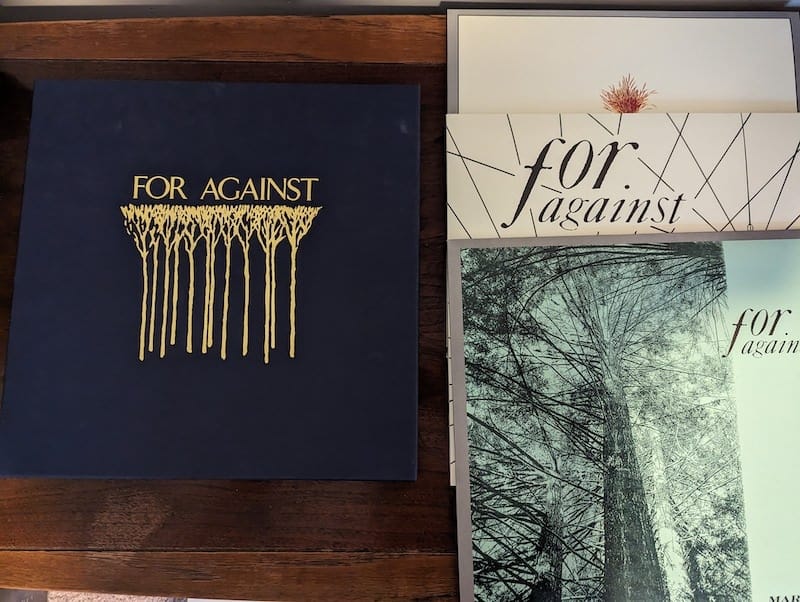
No. 1390: For Against - Box Set
Way back in 2020, pre-pandemic even, I wrote about For Against, an American band that would have fit in pretty comfortably alongside British post-punk groups like The Cure in the 1980s, and on some college radio playlists, probably did. Their best album is the one I wrote about back then, December, which has a remarkable mixture of taut, post-punk energy and dreamy jangle. The Cure isn’t a bad comparison, but it’s almost more like a mix between that group at their ‘80s peak and R.E.M.’s Murmur.
Eventually one album wasn’t sufficient, but some of their classic albums are fairly difficult to track down on their own. Ultimately it made more sense to buy the vinyl box set that Captured Tracks released about 12 years ago, and which I managed to buy just before the last copy was finally sold. Maybe mine was the last copy? Hard to say, but it looks like they’re gone now.
In addition to December, this features their debut, Echelons, as well as the EP/mini-album In the Marshes, which is technically a set of demos, but features some of the most interesting material here. Echelons is excellent, just a few notches shy of December in its blend of more abrasive post-punk and dreamy elements, while In the Marshes is more abrasive, more darkwave, almost even more industrial at times. It’s interesting to hear what they were doing that they ultimately decided against, but it’s a cool snapshot in time all the same. Ratings: Echelons (8.8); December (9.2); In the Marshes (9.0)
Listen: “The Purgatory Salesman”
Reply