- Autobiographical Order
- Posts
- Hailu Mergia, Lightning Bolt, and missing home
Hailu Mergia, Lightning Bolt, and missing home
Plus: Caribou, Charles Stepney, and Karate

Jeffrey Terich
December 29, 2025

No. 1396: Hailu Mergia - Tezeta
I can’t help but miss my old home of San Diego right about now. In part it’s the season, as I’m reminded of holiday parties my wife and I used to throw at our house with our friends—a tradition of sorts that started when my employer stopped throwing holiday parties (and then went bust a couple years later, should have seen the writing on the wall). And as it turns out, this latest batch of records includes a handful that I bought in San Diego during a hot and sticky visit in 2022, when it somehow got hotter than Richmond (where I now live, and which gets pretty hot and sticky in the summer).
The funny thing about each subsequent visit back home (I don’t live there anymore, but it’s always home), it’s always a little bit different than I remember. Some old favorites have closed, a lot of new places open up, there’s new trends, more Teslas etc. It’s both good and bad, but even while I miss some of the places that have closed up shop, it’s always like being a tourist in a familiar place when we explore what’s new. In 2022, a handful of listening bars opened in San Diego, part of a nationwide trend that kinda-sorta capitalized on an idea that originated in Japan but started cropping up in U.S. cities. Only listening bars here are usually just bars that play records and not audiophile isolation booths. That’s the case with Part Time Lover, a bar in North Park that regularly has DJs spinning but always has some vinyl playing regardless.
Naturally, we had to check it out, and it’s a cool enough bar, but the best part is that it has a record store inside the bar, with a selection curated by the proprietor of one of my favorite shops in San Diego. It’s small but stocked with great stuff, including a pretty solid selection of global stuff, and so of course I had to pick up this Ethio-jazz essential while I was there. Hailu Mergia’s had an interesting career, a peer of Mulatu Astatke’s in the 1970s, eventually moving to the U.S. But when his career in music stalled, he started driving a cab in Washington, D.C. After Awesome Tapes from Africa reissued some of his material, he developed an entirely new following and began performing and releasing new music again.
This is one of the ATFA releases, recorded in 1975 and originally released on cassette only (from what I can tell). But it’s full of grooves, with some guitar added to the swirl of psychedelic organ. There’s nothing that connects this record to San Diego at all, really, other than that I bought it there. But here we are. Sense memory—or just memory I suppose—is a funny thing. Rating: 9.1
Listen: “Nefas New Zemedie”

No. 1397: Lightning Bolt - Wonderful Rainbow
Back in the early ‘00s I had a band, a post-hardcore group in the vein of Q and Not U or Jawbox, that went through several members, cycling through three or four drummers, auditioning a bunch more and eventually falling apart because my friend Hubert, the co-founder of the group, moved to New York. It honestly seems like a miracle to me that any band can stay together, let alone for more than five years (I’m currently in a band with my wife that’s been going for a long time with little to no unpredictable x-factor to throw a monkey wrench into the works).
We had a bass player early on that listened to much noisier and weirder music than the rest of us. He introduced me to a lot of bands, like Xiu Xiu and Death from Above 1979. He also, most importantly, introduced me to Lightning Bolt, a band whose 2003 album Wonderful Rainbow remains one of the most thrillingly bonkers things I’ve ever heard. It’s hypercharged noise rock made by a drums-and-bass duo of two guys named Brian, and they’re still going today. They’ve made an impressive number of records without diverting far from this core sound, which is kind of an astonishing feat. Not that this is minimalist by any means—everything moves at an absolutely insane pace, blown out with distortion, chaotic but accessible, fun but absolutely crazy.
As I recall, our bassist put “Dracula Mountain” on a year-end mix CD he made for his friends, which blew my mind on first listen. But I didn’t actually buy this on vinyl until 19 years later, back in 2022 during a fall visit to San Diego. An oppressively humid and sweaty fall visit to San Diego, one in which the heat coupled with some brunch cocktails left me nearly unable to participate in conversation. I’m surprised I didn’t nod off right then and there. But maybe that’s why I needed a record like this, to shake me out of my drowsy heat buzz and make me feel agitated and alive again. Rating: 9.1
Listen: “Dracula Mountain”

No. 1398: Caribou - Swim
The third of my San Diego batch, Caribou’s Swim is a record that takes me back to the early years of Treble. Dan Snaith is in an exclusive group of artists that we’ve essentially been covering since the site first started, and who, for that matter, is still going strong, both as Caribou and as Daphni. In fact, when we started he was still going by the name Manitoba, which changed to Caribou as a result of a lawsuit that still seems absurd in hindsight. But it’s been long enough that it’s unlikely too many people even remember that chapter of his career.
Swim is a good contender for Snaith’s all-time best album (I’m open to entertaining votes for Our Love and Up In Flames, however), both too clubby and beat-driven to be a pop album per se, but too weird to fit in with the more immediate house bangers of his Daphni project, which at the time, hadn’t yet been introduced. This album was released in 2010, and still feels ahead of its time, accessible yet avant garde, immediate and danceable yet not reliant on tropes.
I bought this in the same batch with the Lightning Bolt record and maybe I was in a nostalgic mood at the time, since both records are indie faves from an earlier era. Then again being in San Diego made me feel nostalgic as well. Perhaps it’s inevitable that I’d dip back into the well of some underground classics from years’ past. Or maybe I’m overthinking it, and this is just a record that I didn’t have but Vinyl Junkies did. That’s often all it takes. Rating: 9.2
Listen: “Odessa”
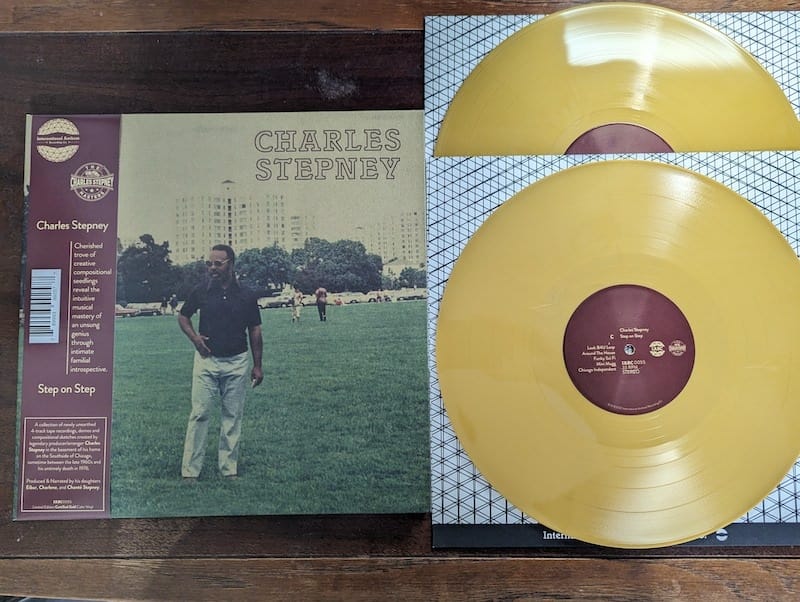
No. 1399: Charles Stepney - Step On Step
We’re just about at the end of another year-end list season, and something that I often think about is that my year-end list isn’t really complete unless it has a few releases from the outstanding International Anthem label on it. The Chicago label has been around for about a decade or so, and has been an instrumental institution in the new generation of jazz innovators, with artists on the label such as Makaya McCraven, Jeff Parker, and SML, who put out one of my favorites this year.
But in 2022, one of the best releases to come out of the International Anthem camp was an archival set of recordings from a producer and songwriter behind some legendary albums, but whose name might not be so well known to many listeners. Charles Stepney worked with artists such as Earth, Wind & Fire, Rotary Connection (and Minnie Riperton) and Terry Callier, and he was also a member of Rotary Connection. But while he never officially released any solo records in his lifetime (he died of a heart attack at age 45—three years before Riperton herself died of cancer at age 31. Damn.), he had archives of solo recorded demos that went unreleased.
Step on Step, released nearly 50 years after Stepney’s death, is a wealth of material from his own solo recordings, some of them sketches of the songs he recorded with Rotary Connection or Earth, Wind and Fire, and many of them just bits and pieces that never saw an official release until 2022. Yet despite the unfinished nature of them, they’re incredible. A song like “Look B4 U Leap” is a deeply funky drum machine banger, while “Black Gold” is something like an instrumental, spiritual jazz demo of Rotary Connection’s “I Am the Blackgold of the Sun,” eerie and mystical and built from relatively stark elements yet suggesting entire worlds within its sparse arrangement.
The music alone is incredible, but part of what makes the collection even more endearing is the addition of Stepney’s daughters talking about his music in brief, spoken interludes, including a track about having one of the first synths ever to come off the Moog assembly line—which leads to a discussion over how to pronounce “Moog” (the track is titled “MiniMugg,” amazingly). It’s a lovingly curated collection, a revelatory set of music, and a beautiful tribute to a musician who left us way, way too soon. Rating: 9.3
Listen: “Black Gold”

No. 1400: Karate - The Bed is In the Ocean
The second Karate album I bought in just a few months’ time—an impulse buy at Deep Groove, if I’m remembering this right—The Bed Is In the Ocean finds Karate farther along in their evolution from punk band to jazz-rock group. That probably sounds like they turned into Steely Dan, but that’s not really what happened, and if anything they were much less of a pop group than The Dan by the time this evolution was complete. I regularly played songs from their 2000 album Unsolved on my college radio show when it was new, and I liked the kind of smoky, low-key sensibility. It was cool, late night music rather than a set of rippers.
The Bed Is In the Ocean is one of the steps between their self-titled, more post-hardcore-leaning record from 1996, one where they’re almost fully committed to the jazzier slowcore sound, but not without giving themselves some room to fire up some rippers like “Diazepam.” I love when they rock, but what keeps me coming back to this record is the nuances, the gentle subtleties and sort of cool, hypnotic ambience of it all. Immediate gratification is great, but I like a record that doesn’t reveal everything at once, that I can grow to appreciate in a new way, and that I don’t hear the same way twice. The Bed Is In the Ocean is one of those albums. Rating: 8.9
Listen: “Diazepam”
Reply